
Key Takeaways
- According to Little Beakers owner Trevor Morgan, half of choosing a science camp is understanding the child who will attend it.
- A child’s answer to what they would spend a whole week on is the best starting shortlist for camp themes.
- Morgan’s fix for a nervous first-timer is to book a friend into the same week and pick the morning session.
- Kids who’d rather watch a demo than do it can test the waters with one Open Lab hour before committing to a camp week.
- Ten minutes of conversation at dinner can prevent booking a great camp that suits a different kid.
Most advice on choosing a science camp is about the camp itself, from the daily schedule to the price. Trevor Morgan, owner of the Little Beakers science labs in Texas and Utah, says that covers only half the decision. His science camp checklist for parents lays out eight questions to put to any camp. Before that, he recommends a short conversation with the child who will be going.
His list has five questions, and he suggests asking them at dinner. The whole conversation takes about ten minutes. Morgan writes that it prevents the most expensive camp mistake: booking a great camp that happens to be great for a different kid.
Question 1: One Thing for a Whole Week
Morgan’s first question is the big one: if the child could spend a whole week on just one thing, what would it be? Whatever comes back goes straight onto the shortlist of camp themes.
The point is to let the child answer without steering. “Don’t lead the witness,” Morgan writes. Rockets and slime are both correct answers, and so are dinosaurs or crime scenes. Little Beakers runs 19 camp themes, and Morgan’s rule for choosing among them is simple: the dinosaur kid should get the dinosaur week, even if a chemistry or engineering week sounds more impressive.
“Obsession is the best teacher,” he writes, and there’s research behind the instinct. In a 2024 controlled study, preschoolers who did hands-on science activities showed higher motivation for science, and some of those kids were only 5. Morgan’s reading suggests that a kid who already cares about the topic will learn on their own.
Question 2: Friends or New Faces?
The second question is whether the child wants to know someone at camp or is happy to meet new kids. Some children like showing up as the new scientist in the room. Others settle in faster when a friend books the same week. Morgan doesn’t rank one above the other. Knowing which kind of child is going, he writes, changes how a family books.
For a kid who runs anxious, Morgan stacks the two easiest options together: a friend in the same week, plus the morning session. Day-one nerves happen, and they don’t usually last. At Little Beakers, camp runs at lab stations, so a hesitant kid has something to mix or measure before anyone expects them to make conversation. Morgan writes that the first experiment usually absorbs a nervous kid, and by day two drop-off is quick.
Question 3: Morning Kid or Afternoon Kid?
The third question is short: “Morning kid or afternoon kid?” Morgan’s view is that children usually know, and that their answer should count for more than whichever schedule is easiest for the carpool.
Younger kids are where this one counts. In Texas, Little Beakers mornings run 9:30 a.m. to 12:30 p.m., and in Utah it’s roughly 9 to noon. Times for each location are on the Little Beakers science camps page. Morgan calls those three hours the sweet spot for little ones, since they get real time at the bench and head home before the afternoon meltdown. Plenty of older kids are happy with full days. He’d match the schedule to the child’s stamina and check that a camp offers both.
Question 4: Watching or Doing?
This one comes with a small experiment of its own. Pull up a video of a science demo, the kind where an adult makes something fizz on a stage, and ask the child afterward: watch that, or do it?
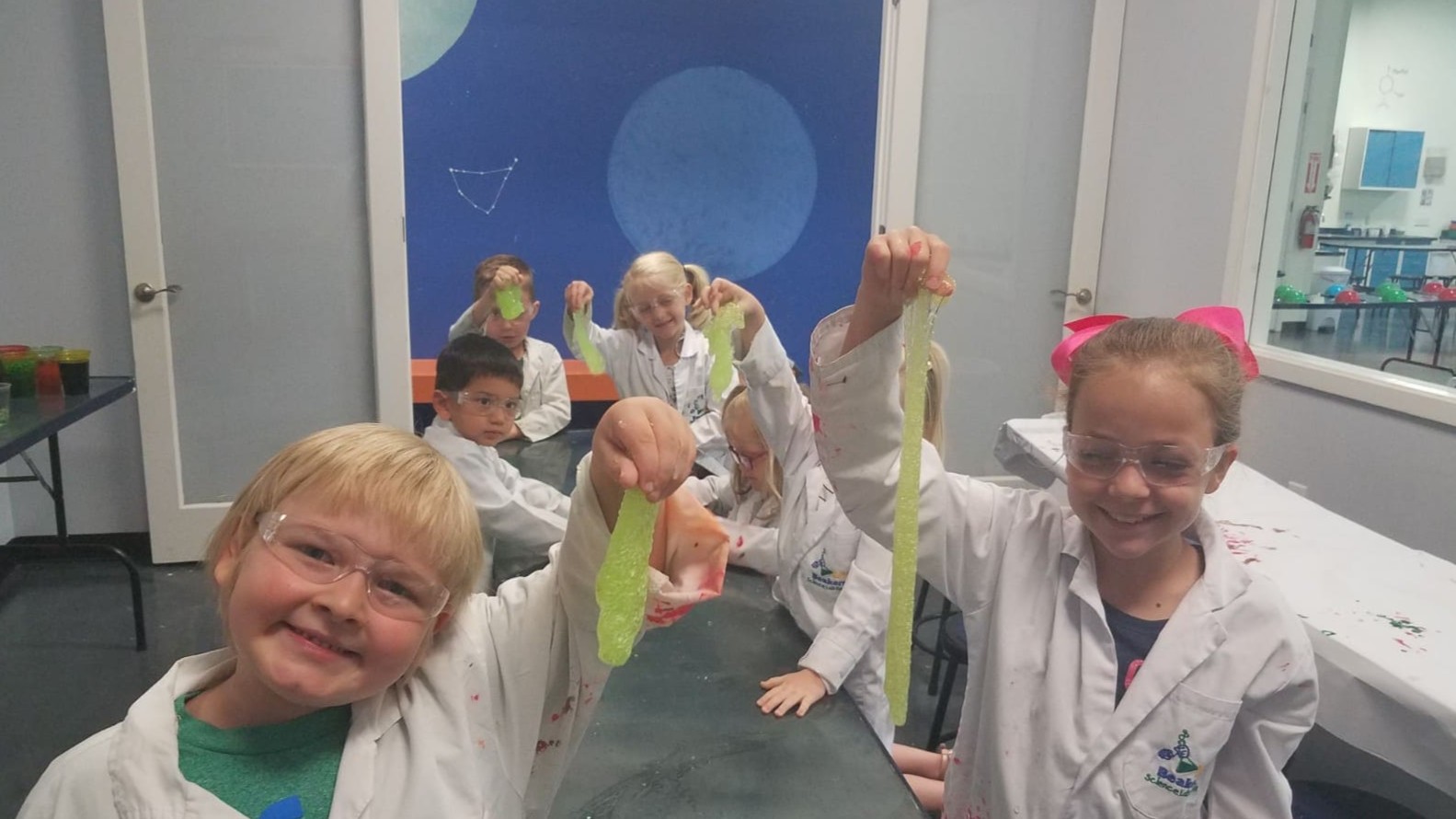
Brochures rarely show how different camp weeks really are. Some are basically a string of presentations with one activity squeezed in at the end. At Little Beakers, a typical camp day has about seven activities and experiments, and every camper does them. Morgan’s guide backs the hands-on approach with a big review in the Proceedings of the National Academy of Sciences: across 225 studies, students in lecture classes were about 1.5 times more likely to fail than students who learned actively.
For a child who really does prefer watching, Morgan suggests a gentler on-ramp before a heavy hands-on week. His pick is a single reserved Open Lab hour, where a family works through self-guided experiments at six lab stations, with more than 30 to choose from. If the child doesn’t want to leave, he writes, the family can book a camp week with confidence.
Question 5: What Would Make It the Best Week Ever?
The last question asks what would make camp the best week ever. Morgan’s point is that children will name the standard they plan to judge the week by. Sometimes it’s the science. Sometimes it’s lunch. He counts both as useful.
His description of what campers bring home suggests what parents can listen for. After a week at Little Beakers, campers come home with a week of made things: polymers, builds, launched rockets and forensic case notes. Many pick up new vocabulary. Morgan’s example is a 7-year-old using the word “reaction” correctly without being prompted. And many come back with a bench partner or two, since kids bond fast over a shared rocket launch. If a child’s best-week answer is about friends or building things, those are details worth checking in a camp’s daily plan.
Turning the Answers Into a Booking
By the end of dinner, a family usually has most of what it needs. A kid who picked rockets, wants a friend along and is a morning kid has already narrowed the field to a few weeks and one session time. If the watching-or-doing test came back “watching,” an Open Lab hour goes on the calendar first. Whatever the child said about the best week ever turns into a question for the camp.
From there, Morgan’s checklist turns to the camp side, starting with how many experiments each child runs personally and how one theme is adapted across ages. It also tells parents to ask whether instructors are background-checked. Every Little Beakers instructor is, and the company runs camps for ages 3 to 16 in Texas and 5 to 16 in Utah during summer, spring break and the winter holidays.
The checklist also suggests asking who designed a camp’s curriculum and whether a scientist was involved. At Little Beakers, the curriculum comes from founder Dr. Cinttya Morgan, a military and aerospace polymers chemist. The Little Beakers About page covers the company and its founder.
Why Ten Minutes Is Worth It
Morgan argues that the questions parents ask at a camp only work once they know what they’re shopping for. A camp with strong staff and a detailed schedule can still be the wrong week for a child who wanted rockets and got botany, or who needed mornings and got full days. The five questions take about ten minutes at dinner. Along with a one-hour trial visit, Morgan counts that conversation among the cheapest steps in the whole process.
About Little Beakers: Little Beakers is a hands-on science lab for kids ages 2 to 16, founded by chemist Dr. Cinttya Morgan, with five permanent locations: Cypress, The Woodlands and Katy/Memorial in Texas, and Sandy and Orem in Utah. The company offers camps, classes, birthday parties, field trips and Open Lab visits. More information is available at https://littlebeakers.com/our-story/ or 1-833-KIDS-LAB (1-833-543-7522).
Little Beakers Science Lab for Kids
1-833-543-7522
13040 Louetta Rd
Ste 226
Houston
Texas
77429
United States


