Wellness is the new refreshment. Every sip is now a health decision, and the beverage brands that understand this will own the next trillion.
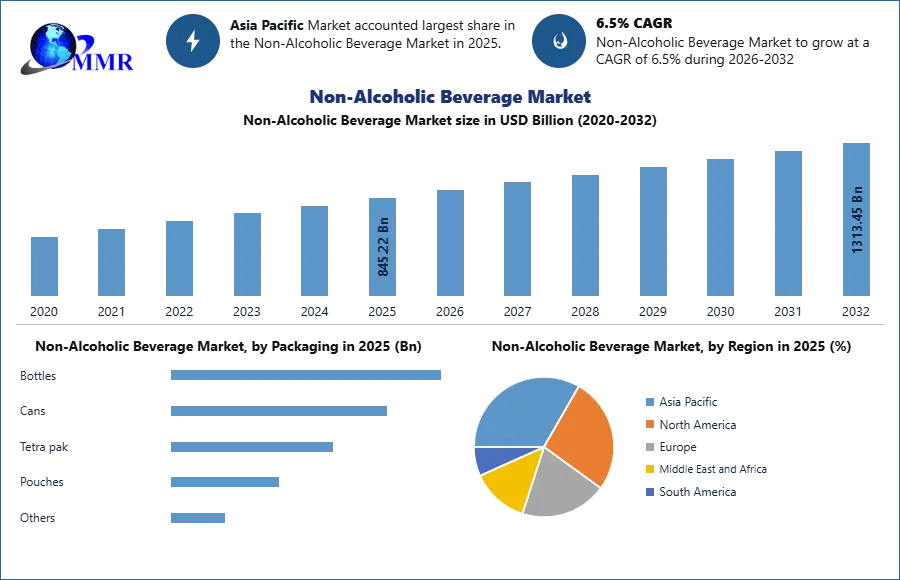
ROCKVILLE , MD, UNITED STATES, April 15, 2026 /EINPresswire.com/ — Why USD 845.22 Billion in Non-Alcoholic Beverages Is Racing to USD 1,313.45 Billion by 2032
Global Non-Alcoholic Beverage Market was valued at USD 845.22 Billion in 2025 and is projected to reach USD 1,313.45 Billion by 2032, expanding at a 6.5% CAGR (2026-2032). This is a structural recalibration of soft drink industry trends: consumers now choose beverages for performance, gut health, immunity, and mindful living, not simply for refreshment. Functional beverages, RTD non-alcoholic beverages, and the zero-sugar drinks market are redefining what it means to compete as a beverage brand. From carbonated staples to adaptogen seltzers and probiotic sodas, the market is being structurally reimagined by wellness-first consumers across every age group and region through 2032.
Get Full PDF Sample Copy of Report: (Including Full TOC, List of Tables & Figures, Chart) @ https://www.maximizemarketresearch.com/request-sample/74039/
WHY CONSUMERS STOPPED DRINKING FOR REFRESHMENT?
Three forces drive the non-alcoholic beverage market. First, Gen Z and millennials treating beverage choice as a wellness decision, propelling functional beverages with probiotics, adaptogens, and nootropics into every retail format. Second, premiumization: consumers paying 2–3x for clean-label plant-based alternatives, converting what was a commodity category into a high-margin specialty channel. Third, the mindful drinking movement pulling mainstream alcohol consumers toward healthy alternatives to alcohol expanding the total addressable market permanently as sober-curious lifestyles enter the mainstream across North America and Europe.
Why Margin Compression, Regulatory Complexity, and Commodity Volatility Are Slowing Challenger Brands ?
The non-alcoholic beverage market faces three structural headwinds. Intense market saturation compresses margin differentiation as global giants and craft challengers compete on identical wellness claims. Regulatory complexity around clean label beverage packaging and sugar disclosure adds disproportionate compliance costs for mid-tier producers. Commodity price volatility in fruit concentrates and sustainable packaging materials creates margin compression throughout the 2026–2032 forecast window with the burden falling heaviest on challenger brands without integrated supply chains.
WHERE THE NEXT USD 468 BILLION IS BEING BUILT?
The highest-value opportunity: RTD non-alcoholic beverages converging with gut-health probiotic sodas, nootropic drinks, and plant-based energy drinks targeting specific wellness outcomes. Clean label beverage packaging and carbon-neutral production are now non-negotiable retail procurement criteria, especially as the impact of Gen Z on the beverage market share makes health and identity signals the primary purchase filter. Brands that anchor claims to clinically-backed outcomes and achieve sustainability commitments early build structural advantages that newer entrants cannot replicate through 2032.
Which Segment, Price Tier, and Channel Are Capturing the Highest-Growth Non-Alcoholic Beverage Demand
Global Non-Alcoholic Beverage Market is segmented by type, price range, age group, distribution channel, and end user. Carbonated drinks lead by volume; functional beverages and RTD tea & coffee grow fastest as functional ingredients in non-alcoholic drinks 2032 drive Young Adult (20–34) purchase decisions. The low-calorie carbonated soft drink market forecast accelerates as zero-sugar and premium tiers converge. Online retail is the fastest-growing distribution channel, enabling functional and craft brands to scale DTC without traditional listing costs.
By Type
Carbonated Drinks
Functional Beverages
RTD Tea & Coffee
Juices & Nectars
Bottled Water
Others
By Price Range
Economy
Mid-Range
Premium
By Age Group
Teens (15–19)
Young Adults (20–34)
Middle-Aged Adults (35–54)
Senior Adults (55+)
By Distribution Channel
Supermarkets & Hypermarkets
Convenience Stores
Online Retail
Specialty Stores
Foodservice
By End User
Households
Foodservice
Institutional
Get Full PDF Sample Copy of Report: (Including Full TOC, List of Tables & Figures, Chart) @ https://www.maximizemarketresearch.com/request-sample/74039/
Who Owns the Sip? Premium Margins vs. Sheer Volume
North America – The Epicenter of Functional Innovation
North America leads in innovation and premium spending, driven by the sober-curious movement and demand for functional botanical spirits. NHTSA and FDA clean-label mandates are forcing rapid reformulations, favoring brands with compliant ingredient stacks. In 2025, Coca-Cola expanded its fortified zero-sugar portfolio, while PepsiCo launched plant-based energy and oat-milk beverages. These moves signal a structural shift toward wellness and 100% recyclable packaging, securing dominance in high-growth sustainability corridors through 2032.
Asia-Pacific – The Volume Powerhouse Turning Functional
Asia-Pacific led the non-alcoholic beverage market by volume in 2025 across China, India, and Japan, anchored by bottled water, juices, and carbonated soft drinks. Health-conscious consumers are accelerating the shift toward sugar-free and low-calorie beverages, functional drinks, and RTD tea and coffee with online retail and packaging innovation fuelling next-generation growth through 2032.
Four Forces That Made The Old Beverage Playbook Obsolete
Gen Z Doesn’t Drink to Fit In – They Drink to Stand Out Gen Z is decoupling beverages from alcohol, treating hydration as a wellness signal. This “mindful drinking” shift made Athletic Brewing a top U.S. brand, proving non-alcoholic beer is a permanent retail fixture. For this generation, choosing botanical spirits over ethanol is a values-driven lifestyle, not a passing trend.
Your Drink Is Now Your Doctor – Probiotics and Nootropics at Scale Functional ingredients like probiotics for gut health and nootropics for productivity are the new competitive axis. Repositioned as “liquid tools,” brands anchoring claims to clinically-backed outcomes command superior pricing and loyalty. This turns every sip into a performance-driven health decision that generic wellness options cannot match.
Consumers Pay 2-3× More – If You Can Prove Every Ingredient The market now rewards transparency, with consumers paying premiums for clean-label packaging and zero artificial additives. As sustainability becomes a non-negotiable retail criterion, brands hitting 100% recyclable targets early build structural procurement advantages. These advantages are difficult for newcomers to replicate in a carbon-conscious economy.
The Shelf Is Dead – Why DTC and Online Retail Rewriting Economics Direct-to-Consumer (DTC) models allow craft brands to scale without prohibitive listing fees. RTD non-alcoholic beverages are ideal for subscriptions, where repeat purchase data and lifetime value economics significantly outperform conventional CPG channels. In this landscape, online agility has become the ultimate predictor of long-term brand longevity.
The Acquisition Arms Race: Why CPG Giants are Buying Innovation Instead of Building It
The dominant market dynamic for incumbents like Coca-Cola, PepsiCo, and Nestlé has shifted from organic R&D to high-velocity acquisition. Because consumer-led functional trends move faster than legacy R&D cycles can pivot, global leaders are increasingly purchasing “ready-made” innovation in the functional and clean-label sectors. The 2024–2025 M&A wave confirms that sustainability credentials and ingredient transparency are no longer just “nice-to-haves”, they are the primary axes of brand differentiation and the ultimate filters for modern consumer purchasing.
Non-Alcoholic Beverage Market Key Players:
Coca-Cola Company
2. PepsiCo Inc.
3. Nestlé S.A.
4. Keurig Dr Pepper Inc.
5. Danone S.A.
6. Red Bull GmbH
7. The Kraft Heinz Company
8. Unilever NV
9. Monster Beverage Corporation
10. Starbucks Corporation
11. Ocean Spray Cranberries, Inc.
12. The Coca-Cola Company
13. Pernod Ricard SA
14. Asahi Group Holdings, Ltd.
15. Suntory Holdings Limited
Get access to the full description of the report @ https://www.maximizemarketresearch.com/market-report/global-non-alcoholic-beverage-market/74039/
Key Recent Developments in the Global Non-Alcoholic Beverage Market
January 2025 – Coca-Cola Expansion Coca-Cola expanded its zero-sugar portfolio and fortified Coca-Cola Plus line while committing to 100% recyclable packaging. This move targets the clean-label mandate, successfully accelerating premiumization and capturing the zero-sugar market across North American retail.
July 2025 – PepsiCo Wellness Launch PepsiCo launched plant-based energy drinks and oat milk beverages backed by a full recyclable packaging commitment. This strategic expansion positions the brand at the intersection of functional wellness and sustainability through the 2032 forecast period.
September 2025 – Keurig Dr Pepper Acquisition Keurig Dr Pepper acquired a minority stake in a leading electrolytic hydration brand to scale its functional water portfolio. This reflects the industry-wide shift toward acquisition-driven innovation, allowing legacy giants to bypass traditional R&D cycles and secure high-growth wellness segments.
2024–2025 – CPG Strategic M&A Industry leaders like Nestlé and PepsiCo are increasingly acquiring functional challenger brands rather than building organic pipelines. This consolidation confirms the mindful drinking movement is now a permanent part of market architecture, rather than a passing trend.
FAQs: Global Non-Alcoholic Beverage Market
Q1. What is the Global Non-Alcoholic Beverage Market size and forecast to 2032?
Ans. The Non-Alcoholic Beverage Market was valued at USD 845.22 Billion in 2025 and is projected to reach USD 1,313.45 Billion by 2032 at a CAGR of 6.5% (2026-2032), driven by functional wellness demand, premiumization, and the global mindful drinking movement.
Q2. What are the functional ingredients driving non-alcoholic drink growth through 2032?
Ans. Functional ingredients in non-alcoholic drinks 2032 include probiotics and prebiotics for gut health, adaptogens for stress management, nootropics for cognitive performance, and electrolytes for active lifestyle recovery. These ingredients are converting beverages from passive refreshment into active wellness tools commanding premium pricing.
Q3. What is the impact of Gen Z on the non-alcoholic beverage market share?
Ans. The impact of Gen Z on the beverage market share is structural: this cohort treats beverage choice as a wellness and values signal, driving demand for zero-sugar drinks, plant-based energy drinks, and healthy alternatives to alcohol that outpace traditional carbonated soft drink growth rates.
Analyst Perspective
The 6.5% CAGR signals a structural transformation, not a temporary trend. A self-reinforcing loop of Gen Z wellness-first identity and premiumization is redefining the competitive landscape. Through 2032, success belongs to brands that anchor functional credibility to clinically-validated outcomes and clean-label packaging. While RTD formats lead growth, online retail serves as the primary gateway for challenger brands, with North America remaining the global epicenter for innovation and M&A investment.
Related Reports
Functional Beverages Market: https://www.maximizemarketresearch.com/market-report/global-functional-beverages-market/7143/
Functional Beverages Market by Product (Energy, Sports, Enhanced Water, Juices), Distribution, and Region Global Forecast to 2032
Plant-Based Beverages Market: https://www.maximizemarketresearch.com/market-report/plant-based-beverages-market/131557/
Plant-Based Beverages Market by Type (Almond, Oat, Soy, Coconut), Application, Distribution, and Region Global Forecast to 2032
Herbal Tea Market: https://www.maximizemarketresearch.com/market-report/herbal-tea-market/79499/
Herbal Tea Market by Type (Green, Black, Herbal/Tisane), Packaging, Distribution, and Region Global Forecast to 2032
RTD Tea & Coffee Market: https://www.maximizemarketresearch.com/market-report/ready-to-drink-tea-and-coffee-market/78617/
RTD Tea & Coffee Market by Product Type, Packaging, Distribution, and Region Global Forecast to 2032
Organic Drinks Market: https://www.maximizemarketresearch.com/market-report/organic-drinks-market/221244/
Organic Drinks Market by Product Type, Packaging, Distribution, and Region Global Forecast to 2032
Top Reports:
About Maximize Market Research Pvt. Ltd.
Maximize Market Research is a premier global consulting firm in Pune, India. Serving clients across 45+ countries, MMR delivers high-granularity intelligence in Food & Beverages, Healthcare, and Tech, empowering enterprises to make confident, data-driven strategic decisions.
Domain Focus
Part of MMR’s Food & Beverages domain, this report covers functional drinks, RTD innovations, and clean-label packaging across 45+ countries. It delivers the intelligence brand strategists and investors need to navigate the global beverage market through 2032.
Lumawant Godage
MAXIMIZE MARKET RESEARCH PVT. LTD.
+91 96073 65656
akash.r@maximizemarketresearch.com
Visit us on social media:
LinkedIn
Instagram
Facebook
X
Legal Disclaimer:
EIN Presswire provides this news content “as is” without warranty of any kind. We do not accept any responsibility or liability
for the accuracy, content, images, videos, licenses, completeness, legality, or reliability of the information contained in this
article. If you have any complaints or copyright issues related to this article, kindly contact the author above.

Media gallery