

Hong Kong, Hong Kong – November 28, 2026
Hongritaworks at the intersection of precision mold engineering and production technology, making the comparison between liquid silicone rubber (LSR) molding and Plastic Injection Molding particularly relevant. Although both processes inject material into a mold, they differ in material behavior, thermal management, tooling design, and production monitoring. Understanding those differences helps manufacturers select an appropriate method for medical, automotive, baby-care, and industrial components without treating the two processes as interchangeable.
How the Two Molding Processes Work
Conventional Plastic Injection Molding generally uses thermoplastic pellets. The material is heated until it flows, injected under pressure, and cooled inside the mold until the part becomes sufficiently rigid for ejection. Melt temperature, injection speed, packing pressure, and cooling time influence dimensions, surface finish, and warpage. The process is suitable for housings, rigid connectors, clips, and many structural components.
LSR molding follows a different thermal sequence. Two liquid silicone components are metered and mixed before entering a heated cavity, where they cure into an elastic part. The feed system is typically kept cool to prevent premature crosslinking. Material-mixing accuracy, mold temperature, cure time, and sealing at the parting line become central control points. Finished silicone components remain flexible and can be appropriate for seals, soft-touch features, and parts exposed to temperature variation, subject to material-grade requirements.
This distinction is fundamental: thermoplastics solidify mainly through cooling, while LSR acquires its final properties through chemical curing.
Tooling Differences: Runner Systems, Cavities, and Part Release
Temperature Control and Material Delivery
Thermoplastic molds rely on cooling circuits to remove heat consistently. Depending on the application, they use cold runners or heated hot-runner systems to deliver molten plastic to the cavities. Poor cooling balance can contribute to dimensional variation, sink marks, or distortion after demolding.
LSR molds usually require heated cavities paired with carefully controlled, cooler material delivery. An effective runner and gate design must limit premature curing, uneven filling, and waste. Hongrita’s LSR/LIM injection molding capabilities include an in-house-developed valve cold-runner approach described on its precision tooling pages. This is particularly relevant to small silicone features, where unwanted flash may interfere with assembly or sealing.
Multi-Cavity Consistency
Increasing the number of cavities can raise output, but it also magnifies variation between cavity positions. For thermoplastics, tooling engineers assess flow balance, pressure loss, cooling uniformity, and repeatable shrinkage. In silicone molding, those concerns are joined by cure consistency, venting, and tight parting-line control.
Hongrita’s published multi-cavity tooling examples describe modular constructions, interchangeable inserts, and cooling technology. Such features illustrate why precision machining and maintenance planning are as important as cavity count. A mold that produces more parts per shot is useful only when each cavity consistently meets the same acceptance criteria.
Demolding and Flash Prevention
Rigid plastic components may be released through ejector pins, sleeves, or other mechanical systems. Flexible LSR parts can stretch, cling to mold surfaces, or become damaged during removal. Tooling therefore needs appropriate release geometry and, where justified, automated demolding. Precise mold closure and vent design also help manage flash, which can be particularly consequential around silicone sealing surfaces.
Process Control: Different Variables, Similar Need for Repeatability
In Plastic Injection Molding, engineers typically establish processing windows for melt and mold temperatures, fill rate, holding pressure, cooling, and ejection. Cavity-pressure monitoring and dimensional inspection can help detect drift. Deviations may appear as short shots, excess flash, shrinkage differences, or cosmetic defects.
An LSR molding solution requires another layer of attention to the metering ratio of the two silicone components, mixing stability, material residence time, cavity temperature, and cure completion. Incorrect settings may affect elasticity, surface condition, or part release. Because cured silicone cannot simply be remelted like a thermoplastic, prevention and early detection of defects are especially valuable.
For either process, a stable production window must be established through trials and validated against the actual part design, material, and intended use. Machinery settings alone do not demonstrate product conformity.
What Hongrita’s Published Tooling Cases Show
Hongrita’s portfolio offers practical examples of how these engineering priorities vary. Its 64-cavity LSR harness plug mold is documented with automatic ejection, a no-flash design, and a 20-second molding cycle. The plug is intended for wire-harness sealing applications, where dimensional consistency and controlled demolding matter. Those figures describe this particular project rather than a general benchmark for LSR production.
Thermoplastic examples on the same precision tooling page include a 128-cavity polypropylene pump-valve mold and a 64-cavity polypropylene syringe push-rod mold. The latter emphasizes interchangeability among molded components. These projects highlight the importance of repeatable dimensions and balanced tooling in high-volume plastic manufacturing, while the harness-plug example adds the specific challenges of silicone curing and flexible-part removal.
Together, the cases show that cavity count should be evaluated alongside material properties, functional requirements, inspection methods, and demonstrated process capability.
Automation and Multi-Component Production
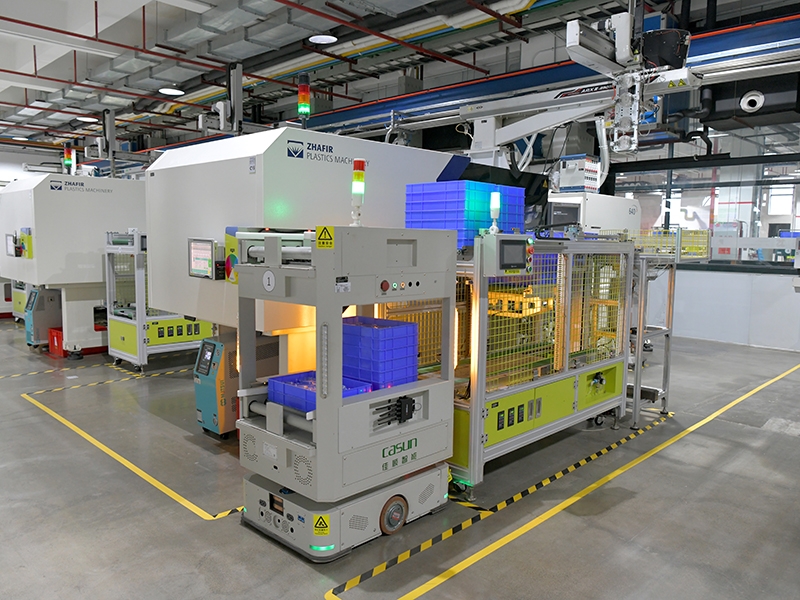
Automation connects mold engineering to consistent handling. Robotic part removal, inspection equipment, and controlled transfer between operations can reduce manual variability. Hongrita describes a production model combining precision molds, configured molding machines, auxiliary systems, and a digitalized intelligent manufacturing platform. The relevant engineering question is not whether a cell is automated, but which sources of process variation it can measure and control.
Multi-component products add another dimension. Hongrita’s documented 2K orange peeler project uses a polycarbonate (PC) substrate with LSR in a 4+4 cavity arrangement, applying an index-plate mechanism for material transfer. The example demonstrates how rigid and flexible functions can be integrated within a coordinated molding sequence. Material compatibility, interfacial bonding, alignment, and cycle sequencing remain necessary design considerations.
Selecting a Process for the Application
A rigid enclosure or dimensionally stable plastic mechanism generally points toward thermoplastic molding, while a flexible seal or soft interface may favor LSR. Components that need both properties may justify a multi-component design. However, the final decision should consider working temperature, mechanical loading, chemical exposure, dimensional tolerances, regulatory requirements, expected volume, and downstream assembly.
Hongrita’s application portfolio spans medical devices, baby-care products, automotive components, and industrial parts. That breadth is relevant because a syringe-related thermoplastic component, an automotive silicone seal, and a consumer product combining PC and LSR pose different validation questions. Material suitability and manufacturing controls should be assessed for each application rather than inferred from a broad sector label.
Industry interest in connected production data, automated inspection, and parts with multiple functions is placing greater emphasis on early tooling and process coordination. These developments make design-for-manufacturability reviews and representative production trials important for both technologies.
Conclusion
The central difference between LSR and Plastic Injection Molding lies in curing versus cooling, with consequences for runner design, temperature control, cavity balance, and demolding. Hongrita’s published tooling and application examples illustrate how these variables are addressed through precision molds, multi-cavity engineering, automation, and production monitoring. Further information on the company’s capabilities is available at https://www.hongrita.com/.
About Us
Founded in 1988, Hongrita is a leading global provider of multi‐material and LSR precision moulding solutions, operating six smart manufacturing facilities across Asia. With strong expertise in multi‐component moulds and integrated moulding systems, Hongrita supports top brands in medical, infant care, industrial, automotive, and smart‐tech sectors. Driven by innovation and Industry 4.0 upgrades, the company delivers high‐value, sustainable moulding solutions backed by award‐winning smart‐factory capabilities.
Media Contact
Company Name: Hongrita
Contact Person: Media Relations
Email: Send Email
Country: China
Website: https://www.hongrita.com/
Press Release Distributed by ABNewswire.com
To view the original version on ABNewswire visit: LSR vs. Plastic Injection Molding: Key Differences in Tooling and Process Control You Must Know